India’s classical dance forms are more than just movement and rhythm—they’re living expressions of devotion, culture, and history. Each dance form tells a story, often rooted in ancient scriptures and spiritual traditions.
Whether performed in temples or on grand stages, these dances connect the physical with the divine. Let’s take a closer look at how these graceful forms of art became powerful mediums of worship and cultural identity.
Origins
The roots of Indian classical dance go deep into history, with references found in the Natya Shastra, a 2,000-year-old Sanskrit text on performing arts. According to this ancient guide, dance was created by the gods to entertain and educate both mortals and celestial beings.
Originally, these dances were performed in temples by devadasis (female temple dancers) as part of religious rituals. Their movements, expressions, and gestures were meant to please the deities and bring spiritual blessings to the people.
Styles
India is home to eight officially recognized classical dance forms. Each one comes from a different region and has its own unique style, costume, music, and storytelling method. But they all share the same goal—expressing emotions and spiritual ideas through body and soul.
Here’s a quick overview of the major classical dance forms:

| Dance Form | Region | Key Features |
|---|---|---|
| Bharatanatyam | Tamil Nadu | Graceful, expressive, temple dance roots |
| Kathak | North India | Spins, footwork, storytelling with hand gestures |
| Odissi | Odisha | Sculptural poses, devotion to Lord Jagannath |
| Kathakali | Kerala | Colorful makeup, dramatic facial expressions |
| Kuchipudi | Andhra Pradesh | Dance-drama style, blends speech and movement |
| Manipuri | Manipur | Soft, lyrical, inspired by Vaishnavism |
| Mohiniyattam | Kerala | Feminine grace, performed solo by women |
| Sattriya | Assam | Monastic dance, tells stories of Krishna |
Expressions
In classical Indian dance, expression is everything. The dancer doesn’t just perform; they become the character, the emotion, and even the god they are portraying. Through abhinaya (expression), every smile, eyebrow raise, or glance carries deep meaning.
The use of mudras (hand gestures) and facial expressions allows dancers to narrate stories from epics like the Ramayana and Mahabharata without speaking a single word. The body becomes a language, and each movement speaks to the soul.
Devotion
At its heart, classical Indian dance is a form of bhakti—devotion. Many performances begin with a prayer or invocation to the deity. Dancers often undergo years of spiritual and physical training, seeing their art not just as performance, but as an offering to the divine.
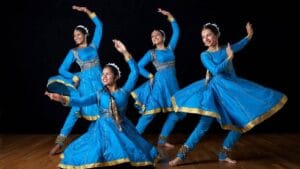
For instance, in Bharatanatyam, each piece in the performance lineup has a spiritual theme—from salutation to a final prayer. Even the stage is treated like a sacred space, and dancers enter it only after seeking blessings.
Music
Classical dance is always accompanied by classical music. The rhythm, melody, and lyrics guide the dancer’s movements and expressions. Whether it’s Carnatic music in the South or Hindustani in the North, the connection between dance and music is inseparable.
Live musicians often accompany the dancer during performances, including vocalists, percussionists, and instrumentalists. This makes the performance more interactive and spiritually charged.
Costumes
The costumes worn in classical dances are not just beautiful; they are symbolic. Rich silks, jewelry, and elaborate makeup all contribute to the character being portrayed. In dances like Kathakali, makeup can take hours to apply and transforms the dancer into a mythical figure.
Each element of the costume, from anklets with bells to forehead decorations, serves a purpose. They help the dancer stay in rhythm, highlight movements, and elevate the overall impact of the performance.
Modern-Day
Today, classical Indian dance is no longer confined to temples. It has found a place on global stages and in modern educational institutions. While some worry about losing traditional roots, many dancers are finding ways to balance authenticity with creativity.
Dance schools across India and abroad are keeping the tradition alive, teaching students not just steps, but the philosophy behind them. Festivals, competitions, and online platforms have also given these ancient art forms a new life.
Still, the essence remains the same—using dance as a tool to connect with something greater than oneself.
FAQs
How many classical dances are in India?
There are eight recognized classical dance forms in India.
What is the purpose of classical dance?
To express devotion, emotions, and spiritual ideas.
Which dance form uses facial makeup?
Kathakali uses elaborate facial makeup and costumes.
Are classical dances still performed today?
Yes, they are taught, performed, and celebrated globally.
What are mudras in dance?
Mudras are symbolic hand gestures used to tell stories.