The Partition of India in 1947 was one of the most significant and painful events in the subcontinent’s history. It marked the end of British colonial rule but also led to the creation of two separate nations — India and Pakistan. Alongside freedom came bloodshed, displacement, and lasting tension. So, what triggered this divide? What exactly happened during those months? And how did it shape the future? Let’s break it all down.
Causes
The roots of Partition run deep, starting long before 1947. While independence was a shared goal, the vision for post-colonial India differed sharply between the Indian National Congress and the All-India Muslim League.
Key causes included:
- Two-nation theory: The Muslim League, led by Muhammad Ali Jinnah, argued that Hindus and Muslims were two separate nations with distinct cultures and religions.
- Religious tensions: Over time, communal clashes and mistrust between Hindus and Muslims escalated, deepening the divide.
- British divide-and-rule policy: The British often played communities against each other, fueling sectarian divisions to maintain control.
- Failure of power-sharing: The Congress-League differences made it difficult to form a united government structure.
- Breakdown of talks: Cripps Mission, Cabinet Mission, and other negotiation attempts failed to reach a consensus.
Eventually, the idea of a single united India was abandoned. Partition was seen as a solution to communal unrest, though it came at a huge cost.
Events
On June 3, 1947, the British government, under Lord Mountbatten, announced the plan to divide India. The Indian Independence Act was passed shortly after, and on August 15, 1947, India and Pakistan became two sovereign nations.
But the process was rushed and chaotic.
Key events included:
- Boundary Commission: Headed by Sir Cyril Radcliffe, this commission had just five weeks to draw new borders between India and Pakistan.
- Division of provinces: Punjab and Bengal were split, both regions with mixed populations, sparking massive unrest.
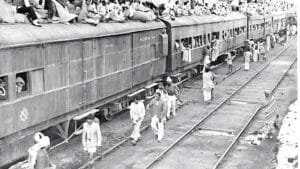
- Mass migration: Nearly 15 million people crossed borders — Muslims moved to Pakistan, while Hindus and Sikhs moved to India.
- Communal violence: The migration turned into a bloodbath. Riots, massacres, and brutal attacks erupted, killing an estimated 1 to 2 million people.
- Refugee crisis: Camps were set up for displaced families, but resources were scarce, and many lived in poverty and trauma.
The violence wasn’t just between communities — neighbors turned on each other, and entire villages vanished overnight. The scars are still visible today.
Aftermath
The Partition’s consequences were felt immediately and continue to echo decades later.
Immediate aftermath:
- Mass displacement: Families were uprooted overnight. Many never returned home.
- Lost heritage: Shared culture, language, and traditions were broken apart by borders.
- Political fallout: Kashmir became a major flashpoint. India and Pakistan fought multiple wars over the region.
- Economic disruption: Cities like Lahore and Calcutta faced severe economic challenges as people fled, industries shut down, and trade routes were destroyed.
Long-term impact:
- India-Pakistan hostility: Diplomatic relations have remained tense, with ongoing issues like terrorism, border disputes, and water-sharing.
- Identity crisis: Many who migrated struggled to fit in and faced suspicion and marginalization.
- Memory and trauma: The Partition has been passed down through generations via stories, films, and literature — often as a story of pain, loss, and longing.
Table
Here’s a quick summary of the key facts:
| Category | Details |
|---|---|
| Year of Partition | 1947 |
| Nations Formed | India and Pakistan |
| People Displaced | ~15 million |
| Estimated Deaths | 1 to 2 million |
| Key Provinces | Punjab, Bengal |
| Key Leader (India) | Jawaharlal Nehru |
| Key Leader (Pakistan) | Muhammad Ali Jinnah |
| Boundary Drawn By | Sir Cyril Radcliffe |
FAQs
Why did India get partitioned?
Due to religious tensions, political differences, and the two-nation theory.
Who drew the India-Pakistan border?
Sir Cyril Radcliffe led the boundary commission.
How many people were displaced in 1947?
Around 15 million people crossed the new borders.
How many died during Partition?
Estimates suggest 1 to 2 million people lost their lives.
Which provinces were divided in 1947?
Punjab and Bengal were split between India and Pakistan.