The Vijayanagara Empire might not always get the spotlight it deserves in mainstream history, but it was once one of the most powerful and advanced kingdoms in South India.
Flourishing between the 14th and 17th centuries, this empire left behind a legacy of stunning architecture, thriving trade, military strength, and cultural brilliance. Let’s uncover how this forgotten powerhouse shaped the history of southern India.
Origins
The Vijayanagara Empire was founded in 1336 by two brothers, Harihara and Bukka, who were previously commanders under the Hoysala kingdom. They established the city of Vijayanagara (modern-day Hampi in Karnataka) on the banks of the Tungabhadra River.
The empire was born out of the need to protect Hindu traditions from the growing influence of Islamic sultanates in the north. Over time, Vijayanagara became a symbol of Hindu resurgence and unity.
Expansion
From a small kingdom, Vijayanagara quickly expanded its territory across South India. At its peak, it controlled parts of present-day Karnataka, Tamil Nadu, Andhra Pradesh, Kerala, and even Odisha.
The empire fought off invasions from the Bahmani Sultanate, Gajapati rulers, and other regional powers. Thanks to its strong military and strategic alliances, it managed to stay in power for over 300 years.
Economy
The economy of Vijayanagara was booming during its prime. Agriculture was the backbone, with an advanced irrigation system and canals built to support farming. But that wasn’t all — the empire was also a major trading hub.
Its capital, Hampi, became an international trading center where merchants from Persia, Arabia, Portugal, and China did business. Goods like spices, cotton, pearls, horses, and gemstones flowed in and out of the city.
Key Exports and Imports
| Trade Items (Export) | Trade Items (Import) |
|---|---|
| Spices | Arabian Horses |
| Cotton | Chinese Silk |
| Gems & Pearls | Persian Carpets |
| Iron & Steel Tools | Portuguese Wines |
The empire minted its own coins in gold, silver, and copper — a clear sign of economic strength.
Culture
One of Vijayanagara’s greatest achievements was its contribution to art, music, and literature. The rulers were patrons of the Kannada, Telugu, Tamil, and Sanskrit languages. Poets, scholars, and artists thrived under their support.
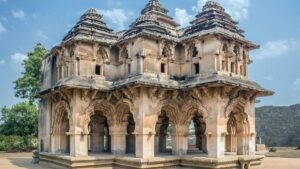
Temple architecture flourished during this era, with grand structures like the Virupaksha Temple and Vittala Temple standing as testaments to their artistic brilliance. Musical pillars, intricate carvings, and towering gopurams were not just beautiful — they were also technically advanced.
Military
Vijayanagara’s military was no joke. It had a well-organized army with infantry, cavalry, and war elephants. The empire also hired skilled archers and horsemen from abroad. Forts were built strategically, and cities were designed with defense in mind.
The Battle of Talikota in 1565 was a turning point. A coalition of Deccan sultanates defeated the Vijayanagara army, leading to the eventual decline of the empire. The capital city was plundered, and much of its glory was lost overnight.
Religion
Though it was a Hindu empire, Vijayanagara was largely tolerant of other faiths. Temples received royal patronage, but so did Islamic traders and Christian missionaries. This inclusivity helped the empire thrive as a melting pot of cultures and beliefs.
Legacy
Even though the empire fell, its legacy lives on. The ruins of Hampi, now a UNESCO World Heritage Site, attract thousands of tourists and historians. Its influence can still be seen in South Indian music, dance, temple architecture, and even city planning.
Vijayanagara was more than just a kingdom — it was a cultural, economic, and spiritual beacon of its time. While the north talks of Mughals and Delhi Sultanates, the south holds Vijayanagara close as a proud symbol of strength and sophistication.
The story of Vijayanagara is one of rise, glory, and fall — a reminder that even the mightiest empires can vanish, but their spirit lives on in stone, story, and soul.
FAQs
Who founded the Vijayanagara Empire?
Harihara and Bukka founded it in 1336.
Where was the capital of Vijayanagara?
The capital was Hampi in present-day Karnataka.
What was Vijayanagara known for?
It was famous for trade, temples, and military power.
Which battle led to its fall?
The Battle of Talikota in 1565 caused its decline.
Is Hampi a UNESCO site?
Yes, Hampi is a UNESCO World Heritage Site.